Thanks to Vehicule Press Gisele Lepin, like a breath of cool clean air, returns. Originally published by Export Publishing Enterprises in 1949 the Vehicule Press edition of Sugar-puss onDorchester Street has a lovely adaptation (by J. W. Stewart) of the original artwork by D. Rickard (note initials on the window). Actually its the art on the Canadian edition. There was a further edition for the American market with artwork by Sid Dyke. And yet a third version on the DJ that is found on the American edition. Will Straw, who introduces the Vehicule edition, talks about buying the American edition in the mid 1980s.
I've done a few posts on the first mass market paperback publisher in Canada - Beaver Publications of Hamilton, Ontario who published three books in 1941. Recently I came across something that I hadn't known about Beaver. I did know that they issued two versions of each of the books - illustrated and unillustrated covers. I speculated that the unillustrated were published for the armed forces. Below is the proof of that - a box with the three books designed to be a gift for a member of the armed forces. It includes a gift card. There is also a brown box version. One of the books in the box is Cherchez la Femme?
Between 1953 and 1957 the Canadian paperback publisher Harlequin Books issued eleven books described as "Harlequin-Pan" editions. The Pan in the description is Pan Books in London. From 1955 until at least the 1970s Pan Books had the exclusive British paperback rights to Ian Fleming's James Bond series and between 1955 and 1957 Pan published three Bond books - Casino Royale Live and Let Die Moonraker Any one of the the three might have been a Harlequin-Pan edition. Alas no. Instead we have five from Edgar Wallace, three from Agatha Christie and three from other authors. Pity. The only one of any interest is A. C. Doyle's The Lost World.
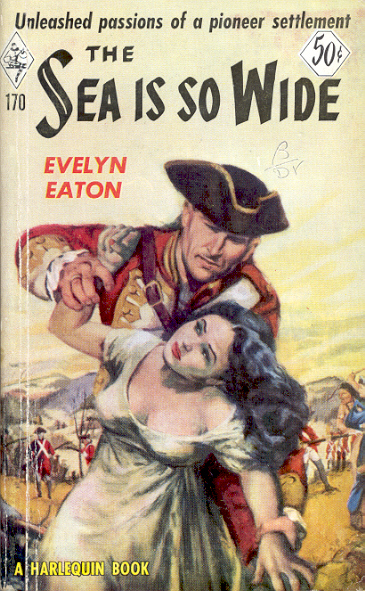
It's a helluva story. So thought Henry Longfellow whose 1847 poemEvangeline, a Tale of Acadie was a best seller. Ninety-six years later Canadian novelist Evelyn Eaton published her The Sea is So Wide. Both use the 1755 expulsion of the Acadians from Nova Scotia as a background to lost love. An early (circa 1851) English edition of Evangeline joins a Harlequin edition of The Sea is So Wide published 101 years later. Surprisingly both remain in print.


.jpg)